
Widget Builder
Overview
Section titled “Overview”The Widget Builder turns governed catalog data into a dashboard widget. It lets you choose a source, select fields, configure the visualization, preview the result, and close the editor after the instant save completes.
How it works
Section titled “How it works”The builder reads the catalog instead of asking you to type technical identifiers. You select business-friendly field names, metrics, dimensions, filters, timelines, and display options. Rokks compiles the selection into a query and returns preview rows. In the dashboard flow, edits apply immediately; the footer shows Close, not a separate Save action.
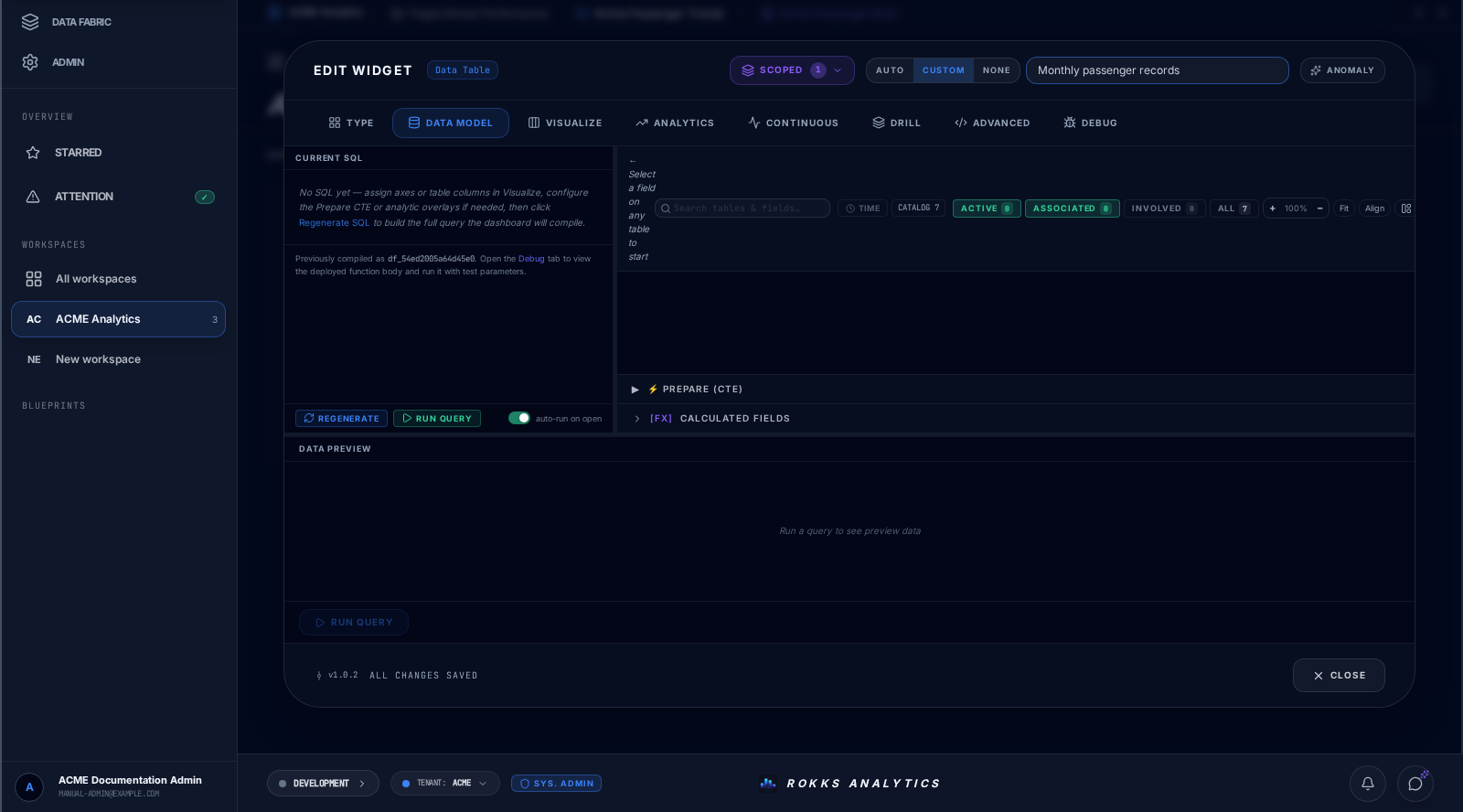
The reviewed beta capture below shows the real editor frame, its catalog-backed schema canvas, live-preview area, and the All changes saved footer. The particular fields depend on the data source and widget you open.
Step-by-step
Section titled “Step-by-step”- Open a dashboard.
- Click Add Widget or edit an existing widget.
- Choose a data source.
- Select the visualization type.
- Add metrics, dimensions, time fields, filters, sorting, or table columns.
- Review the live preview.
- Wait for the instant save to finish, then click Close.
For a chat-driven alternative, ask Sidekick to inspect the governed source in Ask mode, then switch to Agent for one named widget. The dashboard authoring cookbook keeps query compilation and review as an explicit checkpoint.
Common mistakes
Section titled “Common mistakes”Do not build a widget before the source metadata is clean. Poor names and wrong types make the builder harder to use.
Do not use a chart type just because it is visually interesting. Choose the type that answers the question.